Saturday, June 18, 2011

The Sufficiency of Scripture in Choosing Leaders

Well, we are only a little under a year and a half away from another presidential election and the rhetoric has already started, as have the pragmatic calls from professing Christians to vote for just about anyone but the current president.  Far too many professing believers do not take their Bibles to the ballot box and if they do I think it is only used to stand on so they can reach the ballot.  But if we do not seek God’s word for who we are to vote for then our only other alternative is to turn to ourselves and that seldom, if ever, turns out well.  It is when we seek to find candidates that are biblically qualified as God’s word lays out that God is glorified and that is to be our goal.  While we desire to see the tyrannical leadership that is in office removed, our first goal as a child of God is to seek to glorify HIm in our voting.  This does not just happen via the results of an election but in the manner those results are reached.

God is not glorified when we seek to find the “most” qualified candidate.  He is not qualified when we simply seek to find the “least” evil candidate.  However, He is glorified when we vote using His word, all of it, as our standard.  How often does one vote for a candidate that would never be qualified to be an elder or deacon in ones church? But is that not the issue, as even in the church the standards for those God has called to lead us have been so minimized that anyone can fill the position as long as they appear to provide us some benefit.  This is all endemic of an even greater issue and that is the issue of not seeing God’s word as all sufficient.  I say “all” sufficient as many claim God’s word as being sufficient but they only mean, at best, as it relates to “spiritual” matters.  This, however, misses the point that all things are spiritual.  I wrote on the issue of the sufficiency of Scripture some months ago, The Sufficiency of Scripture, ALL of Scripture, and it is still relevant today. 2 Tim 3:16-17 does not just speak to the inspiration of Scripture but also speaks to the sufficiency of it as it is God’s word that equips us for every good work and choosing leaders is a good work that God has called us to take part in.

I write all of this to encourage Gods people to seek God for direction in voting and not to wait till November of 2012, start now.  I hesitated here when speaking of God’s direction to use the word guidance as often the word guidance is seen more about seeking God for suggestions, when in truth God’s word is much more directive.  It does more than simply making suggestions for such things as who we seek to be our leaders.  God sets out qualifications for those He desires us to seek as leaders and not just in the church but also in the nation.  One resource that I found very helpful was a talk given given by Doug Phillips called: Biblical Principles of the Ballot Box (you can also go get the MP3 here).  While some may not agree with the  conclusions Mr. Philips arrives at it will drive one to find biblical rebuttals rather than seeking the pragmatic conclusions which we so often find ourselves doing.  The world may not understand any of this but we are not called to make account to the world for our actions but to God.  Let us be able to stand before God and say we chose candidates that His word directed us to chose and not that we chose candidates that met most or some of His qualification but were the best of the bunch.

Elections are just another test of who we trust, God our something else.  Let us stand with Joshua and be able to say that  “as for me and my house, we will serve the LORD” (Joshua 24:15). It is when we stand according to God’s word in light of all that may look pleasing or best that we most glorify God.  Let us choose all of our leaders by God’s standards and not ours.  Let us seek to support the most qualified men of God that God has placed among us, and they do exist.

Start now to scour scripture for God’s qualifications for the men He desires to lead us and be ready to make decisions based on those very same words.  Do not let the world lead you to think that God’s word is not sufficient to make choices for choosing leaders.  At the end of the day no matter who wins an election God is in control and it is God we will have to answer to and until we begin to reveal to God our reliance on HIm and His word we will get the leadership we deserve.


"Always vote for principle, though you may vote alone, and you may cherish the sweetest reflection that your vote is never lost." -- John Quincy Adams

Wednesday, June 15, 2011

Around the Web and Blogosphere (6/15/11)


Well it has been some time since I have posted one of these, life sure has been busy.

If you want to start an argument try talk about patriarchy.  The problem is that most people seem to either not understand patriarchy or understand it from what they have seen in someone who may have abused it.  The issue is we need to be seeking what God says about leadership in the family and patriarchy is simply the outworking of God’s all sufficient word in the family.  Here is a good article on patriarchy:  The Tenants of Biblical Patriarchy

Here is an article from Bill Roth regarding entrepreneurialism: 7 Signs God Wired You for Entrepreneurship.  I am not sure about you but number 7 is the one I struggle with the most as risk is uncomfortable and who wants to be uncomfortable.  The truth is God will put often put us in positions that may seem risky so that we learn to rely on Him for me entrepreneurism may be one of those areas.

The New Geneva Ambassador School Blog has a good article on government schools entitled: The Evil Conquest of the Government Schools.  Christians need to wake up and realize the nature of the government schools they are willingly sending their children to.

The Winton’s new album Rest Assured is out and it is very good. If you like bluegrass I am sure you will enjoy this album, and their first one.  We are also glad that they will be stopping buy a friends house for a home concert at the end of August, Lord willing.  You can hear some of their music from their first album and couple songs from the new one here.

Thursday, May 19, 2011

How We Walk Reflects Whose We Are

Ever since the fall man has had a desire to be God.  The serpent told Eve “hath God said” (Gen 3:1) and then quickly said, with reference to eating the fruit that was forbidden, “ye shall be as gods.”  This was all done to play on Eve’s desire to be as God, a desire we also struggle with. The truth is that to be like God is not in and of itself wrong if our intention is to walk as He walks (1 John 2:6).  The issue comes when we simply want to be God, when we want to walk as we desire and in the process reveal our desire to be God.  That was Eve’s error, as she wanted to not just be like God but wanted to be as God and thus be autonomous.

This error of autonomy has not been diminished by time.  We constantly hear how man has progressed, evolved, and is improving but a look at the world will reveal something much different.  Man still has a desire to be as God and create his own world and man sees no reason to seek after God for His guidance and direction.  This is expected from the world as it walks in darkness, and loves it (John 3:19), but for those professing Christ to seek to live by their own standards and desires is to deny ones profession.  This desire for autonomy is what John deals with in his letter of 1 John and what our flesh fights against.

Far too many professing believers seem to seek after ways to avoid God’s law rather than scour scripture for how we are to follow it.  We need to, instead, dig deeply into the entirety of God’s word to find what God desires, what He commands, so that we may walk by those commands.  John is clear that how we walk does not save us but he is equally clear that how we walk does reflect whose we are.  We must take verses such as those in John 14 seriously when they speak to reflecting our love for God by our affection for His commands:

John 14:15  "If you love me, you will keep my commandments.

John 14:21  Whoever has my commandments and keeps them, he it is who loves me. And he who loves me will be loved by my Father, and I will love him and manifest myself to him."

John 14:23  Jesus answered him, "If anyone loves me, he will keep my word, and my Father will love him, and we will come to him and make our home with him.

John 14:24  Whoever does not love me does not keep my words. And the word that you hear is not mine but the Father's who sent me.

John 14:31 is for all those that claim to want to walk as Jesus walked but struggle with a call to obey the law;  but I do as the Father has commanded me, so that the world may know that I love the Father. Rise, let us go from here.

When these verses are seen in light of 1 John, as if they were not enough on their own, we should not come to any conclusion but that God desires those that are His to walk by His word, and His word alone.  What is so liberating about 1 John is that John ties Christ’s work to our ability to live as most glorifies God.  This is not about God setting before us an impossible command but instead reveals that God’s call is not simply to a place with Him in the future but to a life lived for Him now. A life lived according to His word and by His power.  We must always remember that our call to God is not about us, even though that is the focus of much so-called evangelism, but about Him.  It is about living a life focused on glorifying Him above all things as our worship of Him  This may be difficult and at times unpleasant but it is not burdensome (1 John 5:3) as God empowers us to worship Him with our lives and that is to be our focus.

To some that have been raised on the pablum of the church of today this call may sound like legalism.  But the issue is that the term legalism is often bandied about in such a way to label anything that steps on our autonomy as such.  Many throw out the word legalism anytime they are called to action, called to live in a manner decreed by God’s word.  Often when one calls for a change in the actions of the church they are equated to Pharisees but this misses one of the issues with the Pharisees, their heart.  Jesus in Matt 23:27 spoke of the Pharisees as whitewashed tombs which we need to see does not denigrate what they did but spoke to the heart behind their actions.  We are to live by God’s word empowered by God given affections for his law, affections that move us to live in a manner that glorifies Him and not us.

The issue is that scripture clearly calls us to live by His commands and this, for those that are truly His, should drive us to His word to find out what this living is to look like.  Let us live by His word, and by His word I mean all of it, and thus show our love for God.  John did not say we would achieve perfection but he did call us to desire perfection (1 John 2:1) in how we live.  Should we fail we have an advocate in Jesus Christ (1 John 2:1).  What a joy it is to know that we are not seeking to live according to His word by our power but by His.

Let us seek to glorify God in all we do and in the process our walk will reveal whose we are.

Friday, April 22, 2011

Download the 2009 NCFIC Sufficiency of Scripture for FREE.

You can download the MP3s from the 2009 NCFIC Sufficiency of Scripture for free here. You can also download them from SermonAudio here.

Thanks to the NCFIC for making this great resource available.

Titles and Speakers:
1) Do Not Learn the Way of the Gentiles ~ Scott Brown
2) The Defining Battles in the War Against the Sufficiency of Scripture ~ Doug Phillips
3) Our Declining Church and Culture - the Genesis Connection and How to Continue a Godly Heritage ~ Ken Ham
4) The Sufficiency of Scripture for Manhood and Womanhood ~ Voddie Baucham
5) The Sufficiency of Scripture and the Heart of the NCFIC ~ Doug Phillips
6) Scripture is Sufficient for Personal Sanctification ~ Andy Davis
7) The Regulative Principle of Worship in the Old Testament ~ Joe Morecraft
8) Scripture is Sufficient for Suffering ~ R.C. Sproul, Jr.
9) English Bibles and the Sufficiency of Scripture ~ Bill Einwechter
10) Scripture is Sufficient for Woman's Ministry Part 1:Teachers of Good Things ~ Jeff Pollard
11) The Sufficiency of Scripture for the Laws of Nations ~ Doug Phillips
12) Scripture is Sufficient for Child Discipline ~ Steve Breagy
13) But How Could a Loving God Say...? ~ Dan Horn
14) The Sufficiency of Scripture for Building Faith and Transforming Character ~ Andy Davis
15) Scripture is Sufficient for Personal Evangelism ~ Paul Washer
16) Applying the Sufficiency of Scripture in the Botkin Family ~ Geoff Botkin
17) The Regulative Principle of Worship in the New Testament ~ Joe Morecraft
18) The Sufficiency of Scripture for Family Life ~ Kevin Swanson
19) God's Law or Chaos ~ Bill Einwechter
20) Scripture is Sufficient for Woman's Ministry Part 2:Keepers at Home ~ Jeff Pollard
21) Is the Sufficiency of Scripture a Biblical Doctrine ~ Joe Morecraft
22) Scripture is Sufficient for Ministry to Youth ~ Scott Brown
23) The Sufficiency of Scripture and the Gospel ~ Paul Washer
24) Scripture is Sufficient for Your Educational Decisions ~ Kevin Swanson
25) The Sufficiency of Scripture for Evangelizing the Nations ~ Paul Washer
26) The Sufficiency of Scripture for the Church Discipline ~ Joe Morecraft
27) The Sufficiency of Scripture for the Importance of the Sabbath ~ Dan Horn
28) The Sufficiency of Scripture for Habits of Obedience ~ Andy Davis
29) Youth Ministry ~ Voddie Baucham
30) The Sufficiency of Scripture and Family Integration ~ Kevin Swanson
31) The Sufficiency of Scripture for Culture as Aesthetics ~ Doug Phillips
32) Scripture is Sufficient to Define and Govern the Church ~ Dan Horn
33) Scripture is Sufficient for Times of Spiritual Decline ~ Bill Einwechter
34) The Importance of Biblical Family Life for the Spread of the Gospel ~ Paul Washer
35) The Sufficiency of Scripture in the Disciple-Making Ministry of the Church and the Home ~ Voddie Baucham

Wednesday, April 13, 2011

What Law do you Love?

Yes that is the question, “What Law Do You Love?”. Not “Do you love the Law of God”, which is a viable question, but “What Law do You Love” since we all love some law. It is either the Law of God or a law of our own making, but we all love some law. Many try and seek to avoid what they label as legalism by claiming to only be held to those commands explicitly found in the New Testament or those things that Jesus mentions. Others will say we do not need the law since being a “New Testament” believer we have the Holy Sprit and thus any attempt to claim a need for adherence to some form of written law is stifling of the Sprit.

What I find interesting with most claims to not needing the law of God, as laid out in all of His word and correctly applied, is that most in seeking to avoid the law set up their own. They in essence create their own form of legalism that others are to be held to. That is what happens when we avoid and ignore God’s law as revealed in His Holy Word. We have an innate desire to uphold some form of Law. Paul in Romans 2:14-15 speaks of this law that is written on the heart of even the unbeliever. This creates a need in man for some form of law but apart from God we can only create the disaster we see today created by the avoidance of God’s law.

As believers, the elect of God, we have the law written on our hearts (Jer 321:1-34) not as some try to read into the passage such that we do not need God’s word. No, this written law on our hearts speaks to the God given desire to please Him in following His word by the power of the Spirit. This is not about a “Get out of the Law” card when we are called by God to Himself. Quite the opposite; as when God calls us and writes His law on our hearts our desire and affections are changed such that we will seek to follow His commands. 1 John 5:1-2 makes it clear that our changed nature will, by God’s design and power, love Him and obey His commandments.

Our natural desire is to be as God and create our own laws. We are by nature “antinomian” but only as it relates to God’s law or for that matter any law that is put over us but our own, or laws we approve of. We see this desire for being the law maker in the garden with the first Adam and this penchant is only broken by the Second Adam. God changes our desires at the cross in that we become a new creation (2 Cor 5:17) not an over hauled creation but a new one. Yes, we still struggle with the flesh such that the desire to still be as God exists in some form. However for the believer, by the power of God, we are not bound to the old desires and affections. That is why John, in 1st John, in speaking to believers can speak as he does and calls them to look at their lives as a testimony to God’s work in them.

I began this by asking “What Law Do You Love? As a Church we need to regain an understanding of God’s Law and its uses and purpose. It is not a means of salvation but a path to walk on due to salvation. The law does not stop working once it drives His people to the cross but once at the cross it is still of use. For too long the evangelism of the church has effectively made Christ’s efficacious work stop at the cross. But it does not. We are called to the cross not for our benefit but for God’s glory. We continue in life after the cross also for His glory and it is by living and walking in and by the light of God’s entire word that we continue to glorify the only one that is worthy of Glory

Whenever I read through the Psalm 119 I repeatedly asked myself how anyone can read the words of the psalmist and still deny our need to love and follow God’s law. The psalmist repeatedly speaks to his love for the law of God. This love is not for what we would term salvation but for its guidance and its glorification of the one who created it. Here are some examples:

Psalm 119:97 ~ Oh how I love your law!, It is my meditation all the day.
Psalm 119:113 ~ I hate the double-minded, but I love your law.
Psalm 119:163 ~ I hate and abhor falsehood, but I love your law.
Psalm 119:165 ~ Great peace have those who love your law; nothing can make them stumble.

Let us turn from our own law and turn to the only perfect law. The only law that leads us to live lives that glorify God, as God desires to be glorified. It is not for us, being imperfect as we are, to decide how we are to live and be the lights we are called to be. It is God in his infinite wisdom and righteousness that dictates our path. Not just in ordaining our steps but in lighting and directing their way by His word.

Charles Spurgeon put it this way with regards to God’s law:

For the Unbeleiver:
“The law is, so to speak, Jesus Christ's dog, to go after his sheep, and bring them to the shepherd; the law is the thunderbolt which affrighteth ungodly men, and maketh them turn from the error of their ways, and seek after God.”

For the Beleiver:
“What is God's law now? It is not above a Christian—it is under a Christian. Some men hold God's law like a rod, in terrorem, over Christians, and say, "If you sin you will be punished with it." It is not so. The law is under a Christian; it is for him to walk on, to be his guide, his rule, his pattern. "We are not under the law, but under grace." Law is the road which guides us, not the rod which drives us, nor the spirit which actuates us. The law is good and excellent, if it keeps its place.”
(Delivered on Sabbath Morning, March 2, 1856)

We must realize we are all submitting to some law. Either the law we create, a law another creates or to that of God. We also need to realize that no matter how we may fight against God’s law we are still held to it. God does not set His law aside simply because we do not obey it. He is not like a child who takes his ball and goes home because no one will play. No, God will be glorified and His law will be obeyed. It is just a matter of what God will do to bring this about. We should understand that the world will object to the law of God and resist it. Let not those who profess Christ do the same.

Let us love the only law worthy of being loved and obeyed, God’s law.

Monday, March 28, 2011

Vision Forum Spring Savings Sale

This week Vision Forum is having a Spring Savings Sale with 40% - 70% off 400+ items.  Also each day there is a special item that is at least 80% off.  Sale ends April 2nd.

Thursday, March 10, 2011

A Review of: A Weed in the Church

Well, I finally got to reading Scott Brown’s book A Weed in the Church: How a culture of age segregation is harming the younger generations, fragmenting the family, and dividing the church. The issue of age segregation in the church is a subject that starts many a disagreement if one should broach the subject as to its detriment to the church especially in the modern youth ministry. Not because of some explicit command in scripture to divide up the church, especially youth, by age but because that is just how things have been done for some time. Scott’s writing of this book is not only timely but a much needed source for looking at how “age segregation” is affecting the church and the biblical approach to discipling youth.

When I first read the title, A Weed in the Church I thought Scott was asking for trouble but I am thankful for his boldness to call modern youth ministry what it is, an invasion into God’s plan for His church, a plan that Scott sets out in the pages of this book. He does so in a way that seeks to try not only show that the present form of youth ministry that is practiced is not prescribed in the pages of scripture but also to show that there is a plan for how to disciple youth in the Bible. For this I am grateful as often it is easy to see that one cannot find anything that looks like the age segregated ministry we see today in scripture but it is not always clearly stated that God has not left us without direction. It is clear that Scott sees scripture as not only sufficient for some things but finds it sufficient for all things, including how to disciple youth.

Scott also shows a love for those that are in modern youth ministry as he does not seek to bash them as he recognizes that they have good intentions and are trying to do what they feel will please God. But he seeks to show that good intentions apart from the commands of God are not the direction we are to go, no matter the immediate benefit we may see. The modern youth ministry of our day is showing that while the short term befits may appear positive in the long run modern youth ministry has failed to develop fully mature disciples of Christ as a whole. This is to be expected when man’s humanistic methods are employed to try and do God’s work, especially when God has set out His plan in His word and we simply need to abide by them.

One thing I personally thought of when I read the title was that as a youth I saw weeds as not necessarily all bad. Often the grass in our yard was dying, probably from the weeds, so the weeds added color and from my perspective were not all that bad. They seemed to accomplish what grass was to do, cover the ground and be green. But at the end of the day the weeds were an intrusion and were not to be there and simply because my perspective did not seem that that way it did not make them a good thing. Such is modern youth ministry as from the perspective of many in the age segregation movement it appears as a good thing but if one seeks to see it from God’s perspective, by reading and studying His word, one begins to see it is not what the church should be partaking in.

A Weed in the Church is broken up into 5 sections with the first being Orientation. Here Scott sets out the lay of the land and sets forth some definitions and qualifications. Next is Evaluation Historical Roots and Current Landscapes that speaks of the “Rise” and “Fruit” of modern youth ministry. The third section is, Multiplying Biblical Solutions for the Discipleship of Youth where he looks at youth ministry and the scriptural picture of what it should look like as well as the results of neglecting true youth discipleship. Fourthly Scott has a section on Answering Objections where he looks at many of the objections that are put forth when the proposition of abandoning age segregated youth ministry is offered up. Lastly Scott writes on Implementation and how one moves from where we are to a multigenerational form of worship.

I highly recommend this book and if you are one who sees great benefit in age segregated youth ministry I can only ask that you read the book with a mind to see what it has to say. Then weigh the content with scripture and let the word of God speak to the subject, as it so clearly does. Anyone seeking to make disciples should have as their one desire that of glorifying God and that does not only happen in the disciple that is developed but also by the method used to make disciples. Truthfully the fruit of ministry over time shows that fully mature and God glorifying disciples are most often produced by the methods God directs in His word. Let us seek to follow those methods and not the methods of man.

Thank you Scott.

Wednesday, February 23, 2011

Free Ticket to “Family Strategies: Practical Issues for Building Healthy Families”

If you are interested in winning a free ticket to Family Strategies: Practical Issues for Building Healthy Families leave a comment that you want to be entered by 5PM (PST) Sunday February 27th.  I will be giving away one free ticket to the weekly messages from Doug and Beall Phillips courtesy of Vision Forum and will announce the winner Monday the February 28th and then you can email me your mailing and email addresses and Vision Forum will get you the information you need sign on for your weekly downloads.

If you do not win a free ticket you can still sign up and here are the details on how it works:
Receive a New Family Strategies Message in Your Inbox Every Tuesday!
Get your new Family Strategies message every Tuesday morning.
Beginning March 1, every Tuesday morning for twenty weeks you will receive a link to your new downloadable message from Doug or Beall, hosted at Vision Forum’s partner website BlueBehemoth.com. To access your first download, simply create a free BlueBehemoth.com account and then follow the easy instructions in your weekly emails to download your messages at no additional charge.
Listen to the messages at your convenience on your computer, iPod, or other portable MP3 player. And, don’t worry if you miss a week due to travel. The messages will be there waiting for you.
Order by March 1 and save $10, plus receive two bonus messages as our gift.
At $85, Family Strategies is a 20-message series sent directly to your inbox each week for less than $5 per message. But make sure you order by February 28, as that price will go up! With your order confirmation email, we will also send you coupons to download two important, family-affirming bonus messages for free: Victories: Moments Small and Large Which Define Christian Parenting, and How to Evaluate a Suitor.

A weekly energy boost for the price of a fancy cup of coffee.
For about the price of a fancy cup of coffee, you can get a real energy jolt — a weekly encouragement boost from Doug and Beall in which they share their favorite and best strategies for building family unity.

Topics to be covered:
1.              How to Organize Your Home to Promote Family Unity
2.              How to Cultivate a Love of Reading with Your Children
3.              How to Make Mealtime Meaningful
4.              How to Prepare for a Year of Home Education
5.              How to Take Children Safely Through an Airport
6.              How to Involve the Whole Family in Family Worship
7.              How to Address the Plague of “Jive Talk” in Your Home
8.              How to Encourage Masculinity in Sons
9.              How to Encourage Femininity in Daughters
10.           How to Handle a Social Worker Visit
11.           How to Wage War on Sibling Rivalry
12.           How to Use Household Decorations to Teach Character
13.           How to Talk to Your Children about Miscarriage
14.           How to Involve the Whole Family in Hospitality
15.           How to Build an Entrepreneurial Spirit in Your Children
16.           How to Watch a Movie As a Family
17.           How to Cultivate a Love of Meaningful Poetry with Your Children, and Why Doing So Is Important
18.           How to Prepare Your Children to Listen to a Symphony
19.           How to Take a Road Trip with Your Family
20.    How to Select the Best Locations for Family Vacations

Tuesday, February 22, 2011

God, Government and the Gospel

If you ever want to start an argument just talk about religion or politics and if you want an even bigger argument speak about both together. Sadly, many professing believers today seek to not commingle the two subjects. Yes they may speak of faith and speak of politics but quite often they do not speak of them as they relate to each other. Of course they may do so when it seems profitable to do so but even then often the attempt is muted. This is even true of many prominent church leaders many of which simply feel the churches lone calling is to proclaim the gospel, as they see the gospel, and that the church should avoid politics. Again, there are times the church will appeal to the Bible on such subjects as abortion and homosexuality but honestly this does not often come across as consistent.

Some in the “professing” church take the stance that many in the secular world take by speaking of maintaining a “wall of separation” as Jefferson spoke of between the church and state. Even though most take Jefferson’s intentions incorrectly and misuse his statements there is a biblical perspective where the state is not to have jurisdiction over the church. However, we as the church must never agree to separation of God from government since God does not see such a separation. Romans 13 is clear that God has a plan for government and that plan does not speak of His people being blindly subservient to the government or to be absent from its function. God’s plan is not what we see so regularly instituted today with government seeking to be God but is a plan where those in government are seen as God’s ministers of justice; justice as defined by God. Thus God desires His people to be involved in the working of the government that He allows to exist.

But how does the gospel enter into the conversation since many think that the church should be about spreading the gospel instead of involving itself in the affairs of state? I think the issue is not whether the purpose of the church is the spreading of the gospel but what is the gospel. The church in many ways has greatly minimized the gospel to being only about salvation from Hell, about escape from eternal punishment. The gospel is indeed good news and that includes much more than is so often put forth by today’s church, that of being saved from Hell. The gospel is about all that God puts forth in His word for His glory and for the good of His people. Seeking a government that functions by God’s all sufficient word would truly be good news. Lest it is misunderstood a Godly government will not save a people but can be used by God to lead men to the cross. This is not about works salvation but above all about glorifying God.

There is an intimate link between God, government and the gospel. A link that sadly is all too often truncated by the church. A truncation that seeks to remove God from government and thus allows government to be left to man and his own reasoning. If the church does not seek to impact government with the truth who can? We are the only ones with the truth since the world can only rely on its own, ever changing, ideals. We need to deliver the whole counsel of scripture so as to have government be the good news God intends it to be. God’s word contains all that is required of and for government to be a government that glorifies God. We need to be the ones that proclaim the good news for all of life that God’s word contains and that again pertains to not some of life but all of life, which includes government. Government will save no one only God can do that but again that does not preclude our part in delivering God’s word in government. Again, if we as the church do not proclaim the truth, all of it, who will. So let us not create a disconnect in life between God, government and the gospel but seek to align all that we do to His infallible and all sufficient word and thus work to give Him all the glory in every area of life. Not for salvation but because of it.

Monday, February 14, 2011

2 Great Resources on Sale Until Feb 18th

With the Coupon code - FAMILYWORKS - you save 40% on the How to Build a Business for God's Glory training series. This is a great deal as it is regularily $134 and is now $79. Offer ends February 18th.


Also the Gospel Missions Collection is on sale until February 18th.


Wednesday, February 02, 2011

The Sufficiency of Scripture, ALL of Scripture

I wonder how many preach that they hold to sola scripture then in essence throw out over half the scriptures. They may give lip service to the OT but do not seek to apply those laws proclaimed in its pages. Often one hears that since we are in the New Covenant we are to only do as Christ proclaims in the New Testament. Well, if one is Trinitarian one needs to be careful about that mindset since Christ is God and thus the author of the OT as well as NT. Many by their actions or in some cases inaction are effectively Marcionites as he too discarded the OT. But if one does not seek to live by “all” of scripture and seeks only the NT for guidance for how to live one discounts Jesus teachings as well. In Mat 5:17, a much misused verse to say that the law is no longer applicable, Jesus proclaims He did not come to abolish the law and then in V18-19, seemingly to answer those who would misuse His words, He adds that “until heaven and earth pass away, not an iota, not a dot, will pass from the Law until all is accomplished. Therefore whoever relaxes one of the least of these commandments and teaches others to do the same will be called least in the kingdom of heaven, but whoever does them and teaches them will be called great in the kingdom of heaven.”

I also wonder how many pastors who are paid for their work, certainly a biblical principle, rely on verses such as 1 Tim 5:17-18 for their wages. But this verse is using the OT ( Deut 25:4 ) as a proof that elders can be compensated. Obviously Paul saw that a correct use of the OT law was applicable to the NT believer.

How often do people use 2 Tim 3:16-17 to speak of the inspiration of scripture and then in effect discard the OT law. This passage in context speaks to the OT and while it obviously applies to the NT as well the original audience would have heard that the OT “was breathed out by God and profitable for teaching, for reproof, for correction, and for training in righteousness, that the man of God may be competent, equipped for every good work.” If we are to follow the words of God, through Paul, we are then to use the OT law as it was intended.

In saying this there is work to be done to understand the principles of the OT law as we do not blindly and woodenly follow them and go and build a parapet on our roof (Deut 22:8). I am also not saying that the ceremonial law is still in effect as it has been fulfilled by Christ who it pointed to. I would also say that while most tend to see the other laws as either moral or civil, in truth they are both moral as the civil laws are an outworking of the ten commandments, the moral law. So I would say we are still left with the moral law as seen in the 10 commandments and the civil codes. Of course we are to discern the biblical principles so as to apply them to all of life. An example is the parapet law found in Deut 22:8 where the principle is a call to responsibility for ones property and not necessarily for building a railing on ones roof, that is unless one has a roof people meet on. Some laws may be easier to discern then others but in the end that does not negate our call to follow them as worship of God.

I realize that for some to hear that we are to follow all of God’s laws, both OT and NT, is legalism. I would say that if one does not seek to follow God’s plan for all of life as seen in “ALL” of His word then you are left with devising your own laws and that is truly legalism. Keep in mind that Jesus did not need to repeat all the OT commands in the NT as they are assumed as valid unless He explicitly negates them, as with the ceremonial laws. Even in Mat 22:36-40 Jesus affirms the OT law as when He is asked about the greatest commandment He does not pick one but summarizes them into those that deal with our relationship with God (Commandments 1-4) and our relationship with man (Commandments 5-10) and in V40 makes sure we do not miss the connection with the OT by reminding us that these two undergird the OT law.

We as a people of God that proclaim to believe in the inerrancy of scripture and the sufficiency of scripture need to live as such. We need to seek to truly live as if God’s word is sufficient and if one does not use the OT and only seeks out the NT for guidance then scripture will not be sufficient. We need all of His word for it to be sufficient and we need to regain this understanding of scripture as sufficient for all of life.

Wednesday, January 19, 2011

A Stance of Advance not Retreat

I was listening to a talk by Dr. Joe Morecraft from the Love the Church Conference where he mentioned Matt 16:18 where Peter is told that “the gates of hell shall not prevail” against God’s church. This is one of those verses that I think the defeatist mentality of many of the church today, often created by faulty eschatology, has influenced how it is interpreted. I say this as I have been there and seen this verse incorrectly for far too long.

What do gates speak of but a stationary edifice, an immovable object? So often this verse is seen from a defensive position in that it is interpreted that Satan’s attacks will not prevail. While that is true the picture this paints is of the church being holed up in the fortress and trying to hold back Satan at the gates. But gates do not attack they protect and in ancient times would be a line of defense in a fortress and often a weakness as they were a means of entry. The picture we should see is more rightly that the church which is to advance Christ’s Kingdom will not fail to do so no matter the attempt of Satan protecting its doomed fortress. In truth the fortress of Satan was already defeated at the cross and will come to final defeat at Christ’s return.

We are to gain confidence in our advance of Christ’s Kingdom in the here in now as the Apostles were to gain hope. We are to truly see the church as victorious and not as some blip on an historical timeline as many paint it. The church, the bride of Christ, is to be on the offensive and not simply sitting back waiting for His return. Let us be the one that storms the gates knowing they will not prevail, that they cannot hold up. Let us not cower in a corner waiting for help when it is here with us to empower us to advance and not retreat. Let us seek to live out Matt 6:10 and not only cry out that “His Kingdom come and His will be done, on earth as it is in heaven.” But let us be used by God’s as His means for doing so. Let us not only speak as if we have hope but live as if we have the hope Christ left in such verses as Matt 16:18.

We are called to be a set apart people of God, let us be so. The gates of hell will not prevail because God has already in effect torn them down. Let us not fear a defeated foe but advance to further Christ’s work in this world He has placed us in. A world that is His already. A world that we are to work to glorify Him in. Retreat does not speak well of our taking God’s word seriously so let us do so and ADVANCE His Kingdom.

Monday, January 17, 2011

Repentance

As I have been studying the Book of Habakkuk it is clear that the message that Habakkuk offers is different than other prophets. His message is of an impending action by the Chaldeans due to Judah’s disobedience but unlike others there is no call for repentance so that the exile would not come. No, this siege by the Chaldeans is assured and will come in Habakkuk’s time regardless of the actions of Judah.

However we know from reading Habakkuk that he sought God’s working to bring repentance to His people of Judah. Thus, there is a call for change and a call for the people to follow God even with the impending gloom of being besieged ahead. There is not offered up a reward for repentance, not a tangible one that is, but instead simply a call to show that God disciplines His people and desires them to repent and follow His ways.

This made me think about how often we, and I have been guilty of this, speak of a reward type scenario when we speak of repentance. We say such things as “Turn or Burn”, or some such statement, implying that the true reward of repentance is not going to hell and thus an avoidance of eternal pain. This is indeed true but it may give a wrong impression and often may even lead to a false Gospel that is focused on man and not God. When we tie repentance to some tangible benefit as in a sales pitch we have played into the humanistic manipulative methods of the market place. We have said if you do this God will do this.

We should realize that if God has truly changed ones heart simply being shown their sin in light of God’s softening their heart will bring repentance. A repentance that flows from seeing ones gross and detestable sinful self in front of a holy and just God. Thus if trials and persecution continue repentance will not be hindered because it was not for the “good life” one repented . Instead, it was because God had changed ones heart to truly see their sin as God does such that repentance was all one could do no matter what follows.

This then makes heaven not about us but about God and being before Him to worship Him for eternity. Let us make sure our evangelism is grounded in glorifying God and not lifting up man. We need to trust God to be the one that changes hearts and not our evangelical sales techniques. God has promised to change hearts ( Jer 31:31-34) let us preach as if He truly does.

By the way here is a link to the sermon series on Habakkuk: Habakkuk Series

Monday, January 10, 2011

Around the Web and Blogosphere (1/10/11)

Public Schools: Tool of the Totalitarian, anti-Christian State: This is an excerpt from Steve Halbrook’s upcoming book (lord willing), God is Just: A Defense of the Old Testament Civil Laws: Biblical Theocracy, Justice, and Slavery versus Humanistic Theocracy, "Justice," and Slavery by Steve C. Halbrook. Copyright © 2010 by Steve C. Halbrook. Based on the master's thesis, God is Just: A Defense of the Old Testament Civil Laws.


Check out my wife and daughter’s blog, Practical Simplicity – For His Glory, as they are having a few “Giveaways” during the month of January to celebrate the 2nd year of business for their online store: Practical Simplicity.


A reminder to check out “What They Said” which is a daily (Monday –Friday) quote blog my daughter (Antoinette) and I maintain. The purpose of the blog is to share quotations of many Reformers and Revolutionaries of the past so that you may be convicted, inspired and uplifted as you read what others have said.


This in an article by Albert Mohler that deals with the issue of retirement, a concept as practiced today that is not found in scripture: For the Sake of the Kingdom: Redefining Retirement

Monday, December 27, 2010

Around the Web and Blogosphere (12/27/10)

A new blog that looks at the war between the states 150 years later: Civil War 150th Anniversary


Via Doug Philips Blog:

Into the Amazon: The Most Feared Beverage in the Amazon from Douglas Phillips on Vimeo.


From Theonomy Resources: The Codes of Moses and Hammurabi Compared (Free Download). There is also a good article entitled: Refuting anti-Theonomy Straw Men: Part 1: Separation of Church and State.


Tuesday Evening Family Discipleship in Sound Doctrine – Early Registration discount ends January 1st. “This webinar series, running from February 1st through March 22nd and October 4th through November 22nd, will cover every section of the Second London Baptist Confession of Faith of 1689”

Vision Forum Year-End Sale

Sunday, December 19, 2010

Thoughts on the Love the Church Conference

Well it has been a week since the conference ended and we have been home for 3 days and I thought it was time to jot down some thoughts on the conference.

In many ways this has been a long two weeks since we drove 2400+ miles to the conference and the same distance home. Combined with the three days of the conference it has a been a very busy 2 weeks. It may be this busyness that has us all sick now. But it has in all been a good two weeks.

The conference started Thursday with a Leaders Luncheon in which many of the speakers shared a little and we also had time to fellowship with others we had not seen for some time. After last year this has a been a good way to start the conference and to get a feel for the direction that many of the speakers were thinking. The conference officially started with Scott Brown Speaking on Christ’s Love for the Church. He spoke of many of the ways Christ loves the church and that we are not to take the church lightly. Doug Philips then spoke on The Gates of Hell Shall Not Prevail. In this talk he went through history to show God’s preservation oh His church. He also listed what he termed “5 Hell Gate Battles”:

1) Battle for Fundamental Orthodoxy
2) Battle over Syncretism
3) Battle Over Lawful Jurisdictions
4) Battle for the Preservation of the Word
5) Battle for Who is the Lord of this World

The first night ended with a talk by Joel Beeke entitled Cherishing the Church. I had not heard Mr. Beeke speak before and he was very good. You could tell from his talk that he truly did cherish the church.

On Friday the day started with a talk by Andy Davis called The Church Described, Portrayed and Illustrated. He spoke of the many Metaphors of the church listed in scripture. From National Metaphors to Religious Metaphors and then Family Metaphors. He finished up in one of the breakout sessions by looking at four other metaphors: Biological, Architectural, Possession and finally Display Metaphors. The second speaker in the morning session was Paul Washer who spoke on the Nature of Conversion. He was as convicting as ever and it is always good to hear him speaks as he makes no assumptions about peoples spiritual state and thus makes sure that everyone hears the gospel.

After the morning session there were three breakout sessions times where one could chose a number of speakers and topics. I went and heard Dan Horn speak on The Lord’s Table for the first session. After lunch and during the second breakout seasons was when I gave my first talk at a conference and it was on Church Planting and its Purpose. This was to be the first part of a three part series that I did with two other men on Church Planting. For the last breakout session of the day I sat in on Jason Dohm speaking on Church Planting and its Practice as this was Part 2 of our series. I need to go back through the MP3s of the conference to listen to the other talks as it is the only way one can hear them all, and they are all worthy of listening to.

After dinner on Friday the evening began with a talk by Jeff Pollard on the Union with Christ.   Mr. Pollard spoke of how in the past this was a popular topic but was now spoken of far to little of late. His talk spoke of the Definition of Union W/Christ, the Nature of the Union W/Christ and lastly the Importance of Union W/ Christ. The next speaker was Scott Brown who spoke on Paganism in the Church. In this Mr. Brown dealt with pagan influences that have entered the church most often through, as Doug Phillips had spoken of, syncretism. He also mentioned that one of the protective principles we have to combat these pagan influences is the principle of “Sola Scriptura.” Within the talk were also given a number of historical and contemporary examples of pagan influences. The last speaker of the night was Paul Washer who spoke on The Tests of Conversion and was as good as ever. He did a great job of speaking on 1st John and how it is the content of ones life n looks at and not just some isolated instances. In this was the call to self examination that we all need to partake in. Thus ended a great day of teaching.

The last day of the conference, Saturday, began with a final set of breakout sessions. I sat in on Steve Breagy’s talk on the Pitfalls of Church Planting as part 3 of the Church Planting series. Once again I will have to listen to the other talks later. The breakout session was followed by Joel Beeke speaking on The Family at Church. Due to a long conversation after the breakout session I was not able to hear this talk but only heard the last few minutes but have been assured it was very good. The next talk was by Doug Phillips and it was concerning Answering Critics of the Family Integrated Movement. He dealt with many of the arguments that have come forth with regards to the FIC. In this he did agree that at times the arguments may have been valid and were taken note of. However, far too often the criticisms have been more hearsay and anecdotal. Thus Mr. Phillips offered a challenge for an academic and well researched and footnoted critique of the FIC.

The last session of the conference was a Question and Answer period and then Scott Brown closed with a talk: Love the Church. Mr. Brown of among other things that the Love of the Church is not simply a love for some nebulous thing but is love of something tangible. Also he spoke of be devoted to praying for the church practicing hospitality and applying what is taught. This was a good wrap up of al that had come before in the previous three days. Thus ended a great conference.

I highly recommend the audio recordings of this conference as they would be greatly beneficial to all. You can buy the audio here: Love the Church Audio.

Here are links to other reviews of the conference:

NCFIC Blog
EventBloggers.com

Tuesday, November 30, 2010

Doctrine of the Trinity-Part 10

After looking at the following:

I) That there are 3 persons (Part 5 & 6)
II) They are all called God (Part 7 & 8)
III) There is One God (Part 9)

We now come to the Fourth proposition:

IV) They must all be God

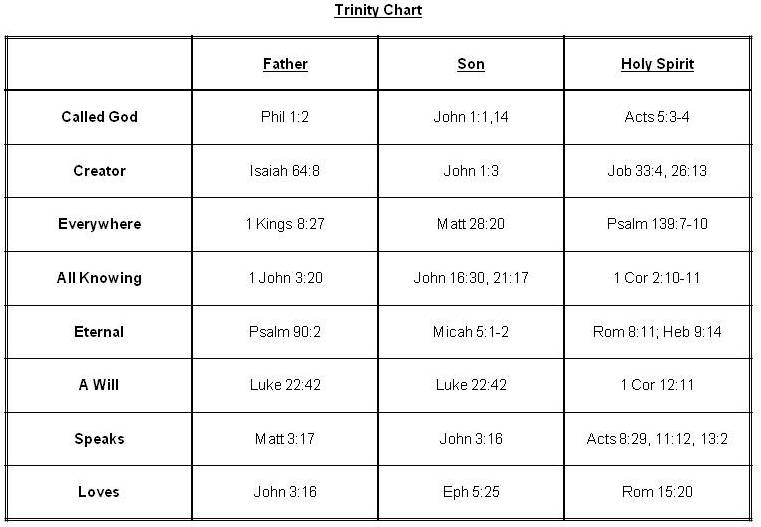
The natural conclusion, regardless of its difficulty to understand/comprehend, is that the doctrine of the Trinity must be true. There are also verses when seen together that show the Trinity such as:

o Acts 3:26 & 1 Thes 1:9-10 - Father Raised the Son
o Jn 2:19-21 Jesus says He raised Himself
o Rom 8:11 - HS raised Jesus
o Acts 17:31 - God raised Christ

It is not the obviousness of the Trinity that sends people off in search of a different answer it is, in my opinion, our arrogance as finite beings in thinking we must all be able to comprehend all that God does and says. We must understand that God has communicated His attributes in a manner that can be clearly seen in scripture and as His people we need to recognize that and believe the word of God. Not because we have it all figured out but because it is just that, the word of God.

Of course for the unbelieving world who are blinded by sin and dead they will not see this but that is not an excuse for professing believers. The doctrine of the Trinity is a litmus test for fellowship between believers. Mind you I said between those that profess Christ, not to become a believer. As was stated early on the issue is with those that simply and forthrightly deny the doctrine of the Trinity. One who denies the Trinity is not a child of God since the “g”od they would claim to worship is not the same one true believers worship, as defined by His word. Again, I would differentiate between one who is struggling to learn and see the truth of the Trinity and one that denies it and especially one that teaches against it

The following is a chart that lists some of the verse already given and what they speak to:

Conclusion
Once we see that the Trinity is true we need to understand how it functions as this seems to be where we may claim the truth of the doctrine of the Trinity but then misrepresent it’s working.

There are distinctions between the three persons of the Trinity. There is an ordering of activities of the Trinity that is sometimes referred to as the “economy of the Trinity”. Whcih refers to the differing ways, or activities , of the three persons of the Trinity

Such as:
o It was God the Father who spoke the creative words to bring the universe into being

o It was God the Son who carried out the creative decrees (John 1:3)

“All things were made through him, and without him was not any thing made that was made.”

o The Holy Spirit was active in a different way as He was seen as “hovering” or “moving” over the face of the waters in Gen 1:2

“The earth was without form and void, and darkness was over the face of the deep. And the Spirit of God was hovering over the face of the waters.”
It needs to be remembered that because the three persons have differing activities this does not take away from their equality. An issue mankind has a penchant for as we so often equate ones job or activity with worth or equality.

In the act of redemption there were differing acts as well:

o God the Father planned the redemption and sent the Son (John 3:16; Gal 4:4; Eph 1:9-10)

“"For God so loved the world, that he gave his only Son, that whoever believes in him should not perish but have eternal life.” ~ John 3:16

“But when the fullness of time had come, God sent forth his Son, born of woman, born under the law,” ~ Gal 4:4

“ making known to us the mystery of his will, according to his purpose, which he set forth in Christ as a plan for the fullness of time, to unite all things in him, things in heaven and things on earth.” ~ Eph 1:9-10

o The Son obeyed and accomplished the redemption for us (John 6:38; Heb 10:5-7)

“For I have come down from heaven, not to do my own will but the will of him who sent me.” ~ John 6:38

“Consequently, when Christ came into the world, he said, "Sacrifices and offerings you have not desired, but a body have you prepared for me; in burnt offerings and sin offerings you have taken no pleasure. Then I said, 'Behold, I have come to do your will, O God, as it is written of me in the scroll of the book.'” ~ Heb 10:5-7
o The Holy Spirit was sent by the Father and the Son to guide and to bring about regeneration or new spiritual life (John 14:26; John 3:5-8)

“But the Helper, the Holy Spirit, whom the Father will send in my name, he will teach you all things and bring to your remembrance all that I have said to you.” ~ John 14:26

“Jesus answered, "Truly, truly, I say to you, unless one is born of water and the Spirit, he cannot enter the kingdom of God. That which is born of the flesh is flesh, and that which is born of the Spirit is spirit. Do not marvel that I said to you, 'You must be born again.' The wind blows where it wishes, and you hear its sound, but you do not know where it comes from or where it goes. So it is with everyone who is born of the Spirit." ~  Jn 3:5-8

These differing roles last for eternity (1 Cor 15:28) but the three are still coequal for eternity in being

“When all things are subjected to him, then the Son himself will also be subjected to him who put all things in subjection under him, that God may be all in all.”
Thus they are equal in being but subordinate in role. Again, existing in eternity past (Eph 1:3-4) as an example of the relationship between the Father and Son in the past.

“Blessed be the God and Father of our Lord Jesus Christ, who has blessed us in Christ with every spiritual blessing in the heavenly places, even as he chose us in him before the foundation of the world, that we should be holy and blameless before him. In love”

So why does this all matter

1) It affects or worship

Keep in mind that worship is not simply what we do one day a week but what we are to do with all our being, in all that we do (1 Cor 10:31)

“So, whether you eat or drink, or whatever you do, do all to the glory of God.”

Also, we are called to worship in spirit and truth (John 4:23-24)

“But the hour is coming, and is now here, when the true worshipers will worship the Father in spirit and truth, for the Father is seeking such people to worship him. God is spirit, and those who worship him must worship in spirit and truth."”

To worship other than the true God is to worship a false God and thus not to truly worship at all. Thus, ones view of the Trinity will affect not only how we worship but who we worship and who we worship with. How we view God also affects our worship since it affects how we decide to interpret scripture, by our understanding/comprehension or by God’s revelation. When truth is lost so is true worship

2) It affects our understanding and proclamation of the Gospel

The Gospel is how God saves men through Christ unto Himself. Change your view of God and you do not have the same Gospel, you do not have the Gospel at all. You will not have a biblical Christ that can save. The God that provides a savior is the triune God of scripture. To define God any other way is to have no God.

3) It affects the rest of our doctrine

To deny the Trinity leads to denying other core beliefs because if one is willing to deny what is clearly taught because it does not make sense it will make it that much easier to change any other doctrine that seems difficult.

We need to be sure that we understand the importance of the Trinity, the cults do. That is why they see it as so important to combat it. Even to the point that the Mormons’ have co-opted the terms. You can speak to Mormon today and they will say they hold to the Trinity, at least those I have talked to have spoken this way. However words have meaning and theirs are unbiblical. One does not need to know how they define God as much as we need to know how we do so.

One proof that the Doctrine of the Trinity is taken lightly today is that people would even have a serious conversation as to whether the Mormon’s are our bother in Christ or not. If you were to ask most professing believers on the street they would not deny them being called Christians.  Thus showing not only their lack of understanding of Mormonism but also of the Trinity.

What we believe about God goes farther than Him being the ultimate being but goes into all that He has revealed through His word. To simply seek for unity around “Christ” without defining Christ is folly. Understanding/apprehending the Trinity from a biblical perspective is part of knowing God and thus Christ. One does not need to understand the Trinity to be redeemed but one that is redeemed will not deny the God that saves and thus will not deny the Trinity.

Let us worship God in all we do and that includes in our understanding of Him.

Doctrine of the Trinity Series:

Sermon Series on The Doctrine of the Trinity:  Part 1   and   Part 2

Part 1
Part 2
Part 3
Part 4
Part 5
Part 6
Part 7
Part 8
Part 9

(all verses used are from the ESV unless stated otherwise)

Friday, November 26, 2010

Vision Forum Sale - Buy 2 Get 1 Free


Until midnight on Saturday, November 27 (CST), mix and match any two items* at Vision Foum and receive a third item of your choice absolutely free!* Your free product can be any item* that is equal to, or less than, the lowest price of your two purchased products.


There is no limit to the number of free items you can receive during this mix-and-match sale — every third item is free!*

This offer is good only for orders placed online and cannot be applied retroactively to previous orders. Free items must be in-stock items. This special buying opportunity expires at midnight on November 27, 2010 (CST), is redeemable only online, and my not be applied to previous orders.

*“Buy 2, Get 1 Free” special offer does not apply to iPods or the 70-Volume Henty Library. The free product will be equal to, or less than, the lowest price of the two purchased products. If a customer qualifies for multiple free products because his order includes at least six items (i.e. “Buy 2, Get 1 Free” x 2), the shopping cart will be reorganized so that the items are listed from highest price to lowest price. Every third item in the shopping cart, from top to bottom, will be marked “free.” This offer will be applied to each increment of 3 products: 3, 6, 9, 12 products, etc. There is no limit!